What is agent trust?
Agent trust is the confidence that your AI agents behave correctly, reliably, and safely in production, and your ability to demonstrate it. So you can reduce your risk of rogue behaviors as you scale your systems in production.
Deployment is outpacing control
Engineering teams are deploying agents faster than their systems can safely support, leading to reliability incidents and rogue behaviors:
-
Unknown reach
49%
have discovered an agent accessing systems they didn’t know it could reach
-
Blocked rollout
71%
cite security and governance as the top barrier to wider deployment
-
No kill switch
30%
could not disable or roll back a harmful agent within minutes
Modern enterprise AI deployments need modern defensive solutions to stay safe, reliable, and trustworthy. That’s why Monte Carlo developed a four-layered approach to agent trust.
Monte Carlo's four layers of agent trust
None of them holds up in isolation, and none can be checked periodically. Agent trust means watching all four, continuously, in production.
Context
Is the data and information the agent retrieves accurate, fresh, and complete? Stale or broken context fails regardless of how capable the model is.
Performance
Is the agent completing tasks efficiently, within expected cost and latency? Slow or expensive agents don't scale, even when technically correct.
Behavior
Is the agent reasoning and acting the way it's supposed to? This is where silent failures hide. Outputs can look fine while the reasoning underneath drifts.
Output
Is what the agent ultimately produces accurate, faithful to its context, and safe? Output is the last line of defense, which is why it can't be the only one.

Operationalizing agent trust inside Monte Carlo
Monte Carlo is built for trust in the agent era. With a platform architecture that supports secure, flexible deployment, an MCP server to add gates into your own AI coding environment, and an AI-native engineering organization that uses our own products – we are serious about a culture of trust.
How to build an AI-native engineering org
What actually changes when an engineering team builds with AI by default — and how structure, review, and the quality bar have to move with it.
Read the post: How to build an AI-native engineering org
Why AI agents go rogue
The failure modes behind agents that drift off task, and why so many of them trace back to the data underneath rather than the model on top.
Read the post: Why AI agents go rogue
How Monte Carlo’s reinforcement loop caught a silent issue in our own troubleshooting agent
Our troubleshooting agent developed a quiet failure that no alert would have caught. Here is how the reinforcement loop surfaced it, on our own stack.
Read the post: How Monte Carlo’s reinforcement loop caught a silent issue in our own troubleshooting agent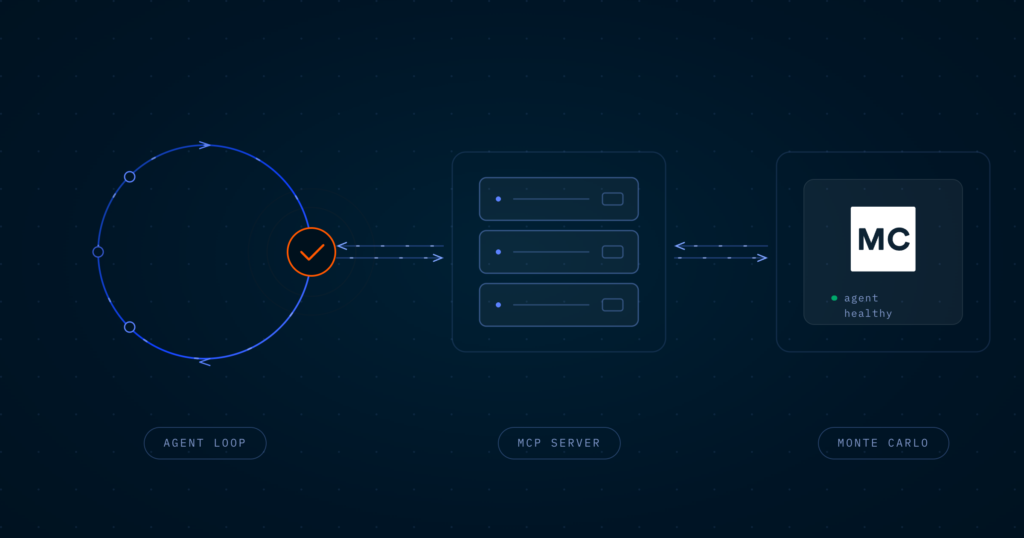
Accelerating agent trust with Monte Carlo’s MCP server
Putting data health context directly in front of the agents and assistants your team already works in, so trust travels with the data.
Read the post: Accelerating agent trust with Monte Carlo’s MCP serverTrust is a loop, not a checklist
Monte Carlo monitors the observable dimensions of trust via an agent-driven loop. Agents detect, triage and recommend resolutions for every incident. Your agents get smarter with every run, and your system becomes more trustworthy over time.
Detect
Surface issues and opportunities across every layer — data, context, behavior, and output — as they happen.
Triage
Assign impact, priority, and ownership, so the right person or agent picks it up immediately.
Resolve
Troubleshoot and correct the issue, with humans in the loop for the decisions that need one.
Adapt
Tune the system to optimize future performance, so the same failure doesn’t happen twice.
Agent trust in action

How the NY Jets grew their AI deployments by 10X, leaning on Monte Carlo to maintain trust and safety across both the data and agent layers of their infrastructure.
Read the case study: NY Jets
How Axios leans on Monte Carlo to accelerate newsroom velocity via more than a dozen LLM agents, maintaining reporting accuracy and integrity throughout
Read the case study: Axios
How Monte Carlo helps Nasdaq deliver trusted data across 30 exchanges and 2,200 financial institutions, in a heavily regulated industry.
Read the case study: Nasdaq
How Morningstar responds to data alerts 50% faster — and catches its earnings agent drifting toward language that reads as financial advice.
Read the case study: MorningstarMonte Carlo is the agent trust platform that covers the full stack
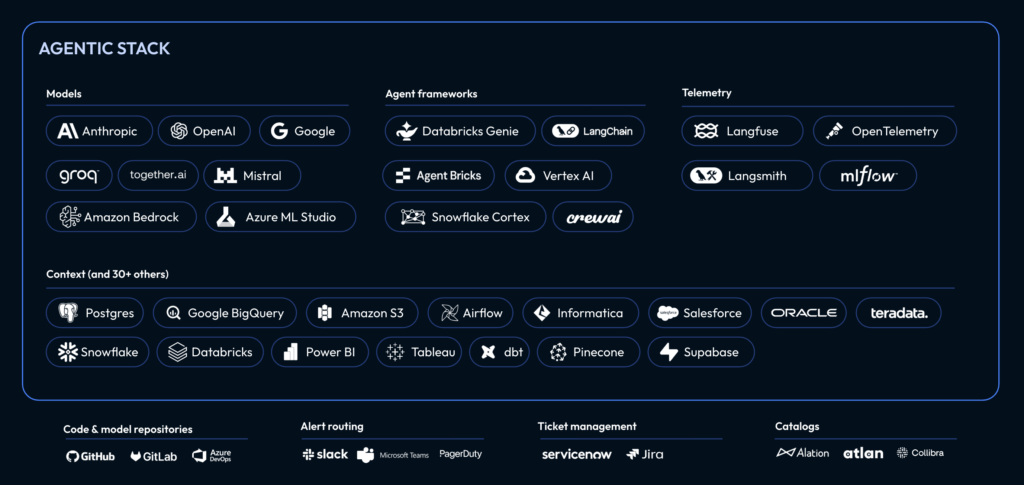
With native integrations across the modern data stack, teams get lineage from raw data in the warehouse all the way to the action an agent takes. So when something breaks, you can trace it back to the exact pipeline failure, model change, or context drift that caused it.
Axios
“We were using Monte Carlo to observe our data ecosystem and our ML model predictions, so being able to incorporate agent observability workflows in just a few clicks with the same familiarity for how we set up our monitors, and alerts, and get observability across our whole platform was attractive.”
 SS
Shreye Saxena
Senior Data Scientist at Axios
Agent trust, answered directly.
Is agent trust the same as agent observability?
No. Observability is one of the mechanisms through which organizations can achieve agent trust, alongside AI optimization. Observability gives you the ability to trace an agent’s inputs, reasoning, and outputs. Trust is the ultimate outcome: the confidence that results once that visibility confirms the agent behaves correctly.
Is agent observability the same as data observability?
They’re related but distinct layers. Data observability asks whether the data feeding an agent is clean, complete, fresh, and flowing properly. Agent observability examines an agent’s performance downstream of the data, including tool calls, trajectories, performance (i.e. errors, latency), and final outputs. Full-stack agent trust needs both.
Is agent trust the same as AI security?
Not in Monte Carlo’s usage. The security definition, following Forrester’s named category, is about verifying an agent’s identity and authorization. Monte Carlo ensures reliability once an agent is authorized to act. Both matter, and they are part of a growing field of defensive technology in the face of increased AI risk.
How is agent trust measured?
As a composite of four continuously monitored dimensions — context quality, performance, behavior, and output — rather than any single metric or periodic spot-check.
How does Monte Carlo approach agent trust?
Monte Carlo is the agent trust platform that unifies data and agent observability to monitor, troubleshoot, and improve production AI systems over time. As enterprises prepare to deploy thousands of agents across business-critical use cases, Monte Carlo provides the reliability infrastructure to support them along this AI transformation, from human-guided agents to fully autonomous operations. Founded in 2019 and backed by leading investors, Monte Carlo empowers data and AI teams to ship trusted AI at scale.
See how enterprises put agent trust into production
Trusted by 400+ enterprises