7 Ways to Improve AI Token Efficiency and Cut Your LLM Bill

Every prompt you send, every chunk of context you stuff into that window… it all costs tokens. And tokens cost money. Meanwhile, token prices have actually been falling – so if your bill keeps climbing anyway, waste is almost always the reason. It pays to get a handle on it.
That’s where the idea of token efficiency comes in, or using fewer tokens in your AI systems without losing output quality.
The teams that figure out how to do more with fewer tokens are not only saving money, they are able to build faster and more reliably at scale. So let’s talk about how to get there.
How to Cut Your LLM Costs Without Cutting Corners
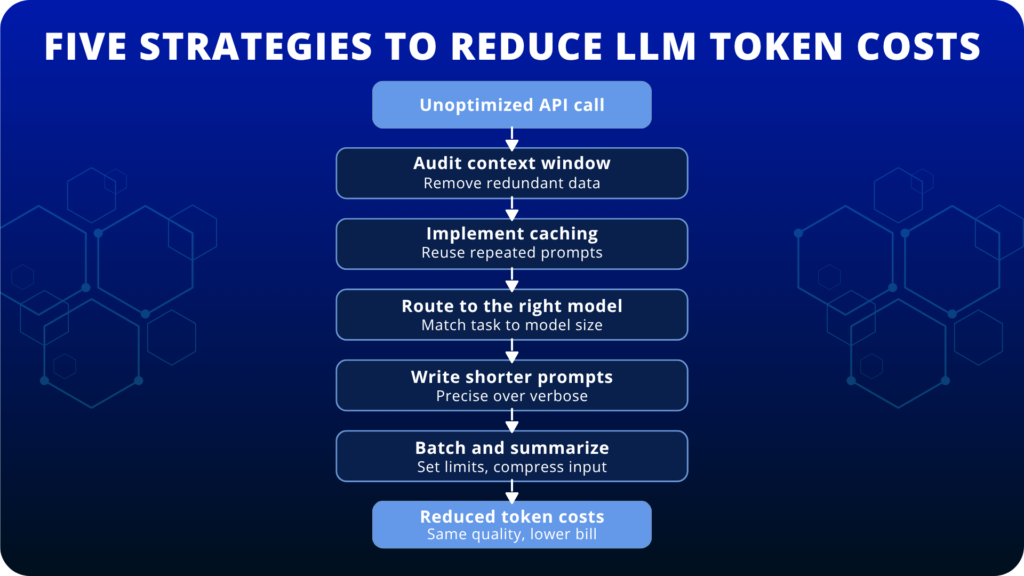
The first thing worth doing is taking an honest look at what you’re sending in each API call. It’s like opening your closet and realizing half the stuff in there doesn’t fit anymore. Most teams discover they’re packing context windows with redundant instructions, boilerplate, and data the model never needs. Monte Carlo’s own engineering team found that teams routinely waste 30–40% of their token budget this way.
Use Prompt and Semantic Caching
Once you’ve trimmed the fat, caching is your next big win for AI token efficiency. If you’re making repeated calls with similar inputs or identical system instructions, prompt caching can remove a huge chunk of duplicate token usage without impacting your outputs at all. For near-duplicate prompts, there is even semantic caching for matching similar content. Either way, you stop paying for work the model has essentially already done.
Route Tasks to the Right Model
Another move that pays off quickly is routing tasks to the right model. Not every request needs your heaviest, most expensive option. Do you have simple classification or extraction tasks? Send those to a smaller, cheaper model instead. Save the big guns for complex reasoning where they actually make a difference.
Write Better Prompts
On top of routing, a well-structured prompt makes a bigger difference than most people realize. Clear delimiters, concise role instructions, and thoughtfully organized few-shot examples mean the model spends less effort parsing your intent and more time doing useful work. And shorter, more precise prompts aren’t just cheaper, they often also produce better results, since LLMs tend to get confused by walls of text just like the rest of us.
It’s worth spending some time on iterative prompt refinement, too. Test different variations, measure token counts alongside output quality, and ruthlessly cut unnecessary verbosity. Once you’ve landed on a strong prompt, a few output-side tweaks can squeeze out even more efficiency:
- Instruct the model to respond concisely so it doesn’t pad answers with filler.
- Use structured output formats like JSON to keep responses tight and machine-readable.
- Set stop sequences to end generation the moment you have what you need.
Batch and Limit to Save Even More
With your prompts dialed in, there are a handful of other quick wins that stack up fast:
- Batch similar requests into single API calls instead of firing them one at a time.
- Set sensible max-token limits so the model doesn’t ramble past what you really need.
- Summarize long documents before they hit the context window rather than feeding in the full text.
Put all of these together and your AI token efficiency will improve fast without sacrificing quality.
But none of these tactics matter much if you can’t tell whether they’re actually working. That’s where tracking comes in.
Track Where Your Tokens Are Going
You can’t optimize what you can’t see, and most organizations have a general sense of their total bill, but if you asked them which team, app, or prompt template is driving the biggest chunk of that spend, they’d just shrug.
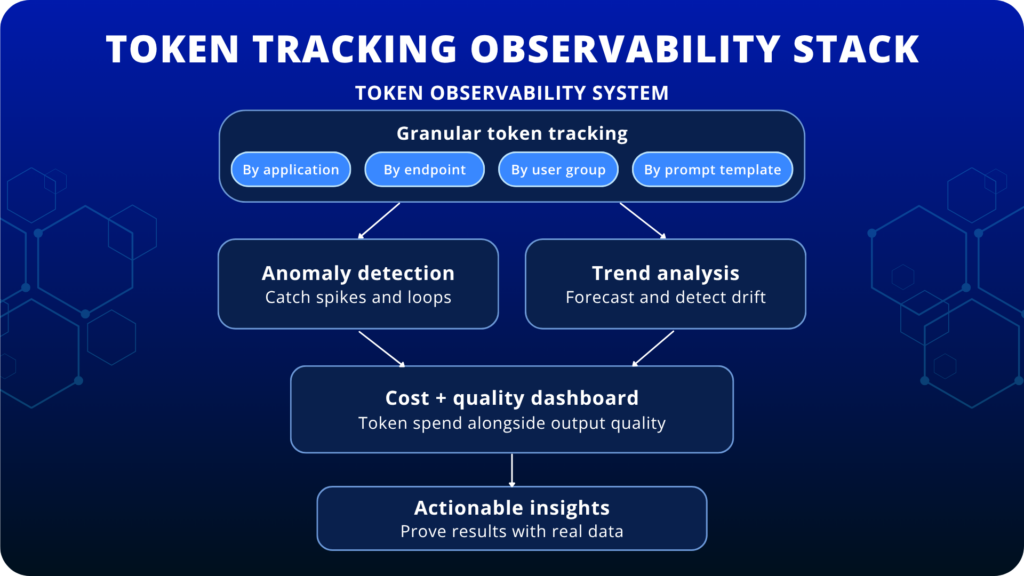
That’s a problem, because the path to lower costs starts with visibility. So set up granular token tracking broken down by application, endpoint, user group, and prompt template. Now when you can see exactly where that usage is coming from, the optimization opportunities practically jump off the screen.
It’s also worth building in some anomaly detection while doing this. A sudden spike in token usage might mean a popular new feature is getting heavy traffic, or it just might mean a bad deployment is firing the same bloated prompt in an infinite loop. Without monitoring, you won’t know the difference until the invoice shows up at the end of the month.
Trending this consumption over time also helps you forecast costs, spot gradual inefficiencies like templates ballooning as people tack on “just one more instruction”, and prove that your optimization efforts are really working.
Pair Cost Metrics With Quality Metrics
One last piece: make sure your dashboards show these cost saving metrics right alongside output quality metrics. Cutting costs is only a win if the results stay high quality. When you can see both at a glance, you’ll know immediately if an efficiency tweak is saving money or just degrading your outputs.
Last but not Least, Optimize Your Data Pipeline for Better AI Token Efficiency
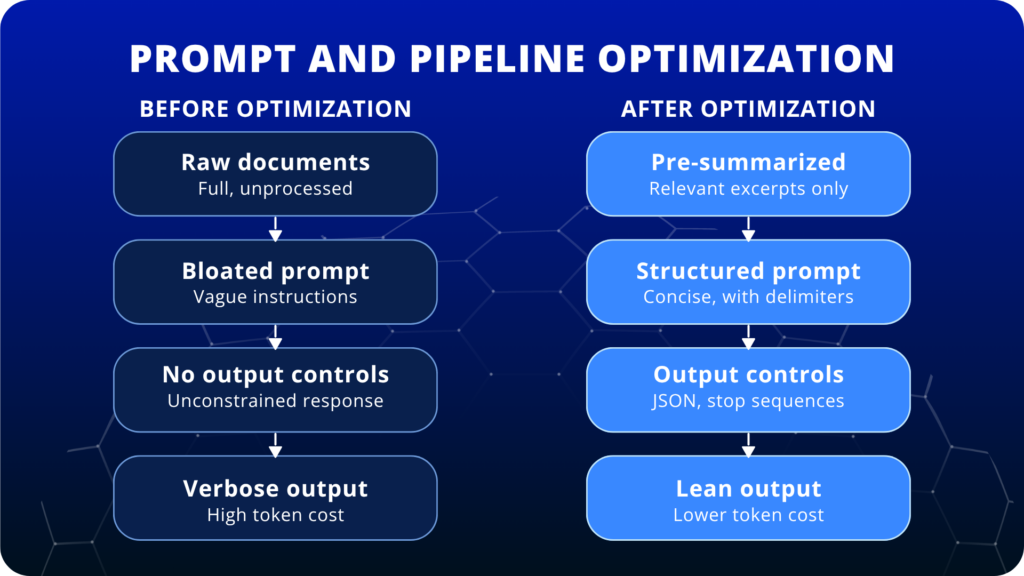
Your data pipeline is often the biggest hidden source of token waste, and it’s one that most teams overlook while they’re busy tweaking prompts. Feeding raw, unprocessed documents straight into the context window is one of the most common (and expensive) mistakes out there. Instead, pre-process that content – summarize it, extract the relevant pieces, and send only what the model actually needs to do its job. Poor data quality upstream makes every token downstream less effective.
If you’re using retrieval-augmented generation (RAG), tune those pipelines to return fewer, more targeted chunks. The goal is precision over volume. Every irrelevant chunk you retrieve is tokens spent on noise instead of signal – and as retrieval drifts, the problem compounds quietly over time.
These pipeline-level adjustments compound quickly, especially at scale. And they’re the kind of thing that separates teams who are just optimizing on the surface from those who are actually building efficient systems end to end.
Keep Your Token Efficiency Gains From Falling Apart
All of these strategies rest on one assumption: the data flowing into your AI systems is accurate, fresh, and properly formatted. When that breaks, your carefully tuned prompts start burning tokens on garbage inputs that produce garbage outputs. Building reliable AI means catching those issues at the source.
Optimizing prompts while ignoring data pipelines is like tuning a race car engine but never checking the fuel. That’s where data observability comes in. Monte Carlo created the category and now provides AI + data observability that tracks the four components where AI fails (data, system, code, and model) so upstream problems don’t inflate your costs. With Agent Trust, you can scale AI agents knowing the data behind them is solid and your efficiency gains will hold up over time.
Leave your email below to see how Monte Carlo can help you monitor, troubleshoot, and get more out of every dollar you spend on AI.