Cheaper Tokens ≠ Cheaper Agents

Token prices have fallen fast. According to Stanford’s AI Index, the cost to run a GPT-3.5-level model dropped from about $20 per million tokens in late 2022 to $0.07.
If you priced your agent budget on that curve, your bill should be shrinking and you should be getting cheaper agents, right?
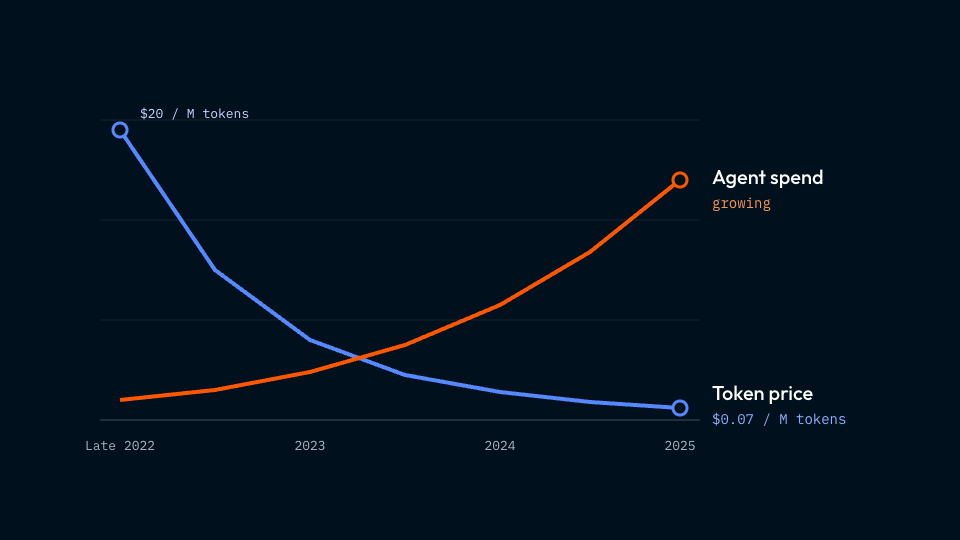
For most teams, agent spend is growing.
The reason is simple: you don’t buy tokens.
You buy finished work: a claim checked, a ticket resolved, a question answered correctly. The token price is one input into that cost, and usually not the one that decides it.
Here’s where agent costs come from, and how to measure them before you lock next year’s budget.
Where the tokens go
Context grows every turn. A multi-turn agent resends its full history on every call. A conversation that starts at 5,000 tokens can pass 40,000 by turn ten. Every evaluation you run on that conversation pays for all of it again. Cut the token price in half and a long conversation can still cost more than a short one did last year.
Retries run quietly. A tool call times out, and the agent tries again. A malformed response triggers another attempt. An agent bounces between two tools because neither gives it what it needs. None of this throws an error. It simply shows up as a bigger invoice and a slower answer.
One request becomes five. Agents call other agents, and each one brings its own context, its own tool calls, and its own retries. Multiply that across every team that shipped an agent this year, and you get the same question answered three times by three agents nobody has compared.
Where the money goes beyond tokens
Bad context costs twice. An agent that retrieves a stale table or a duplicate document burns tokens reading it. Then it gives a worse answer, and a person spends time catching and fixing it. You pay for the mistake and the cleanup.
A cheaper model can make a more expensive agent. Teams are splitting work across models, keeping frontier models for hard tasks and routing everything else to cheaper open or internal ones. That can pay off. It can also backfire. A smaller model that needs more turns, more retries, or more human review costs more per finished task, even at a fraction of the token price. And every model behaves a little differently, so a prompt tuned for one model can drift on the next without a single error. Every model swap is a production change.
The biggest costs never appear on the invoice. Human review of agent output, rework when an answer was wrong, and escalations from customers who got that answer.
Engineers maintaining homegrown monitoring instead of shipping the next agent. None of it shows up in your provider’s billing dashboard, and all of it belongs in your agent ROI.
Measure cost per completed task
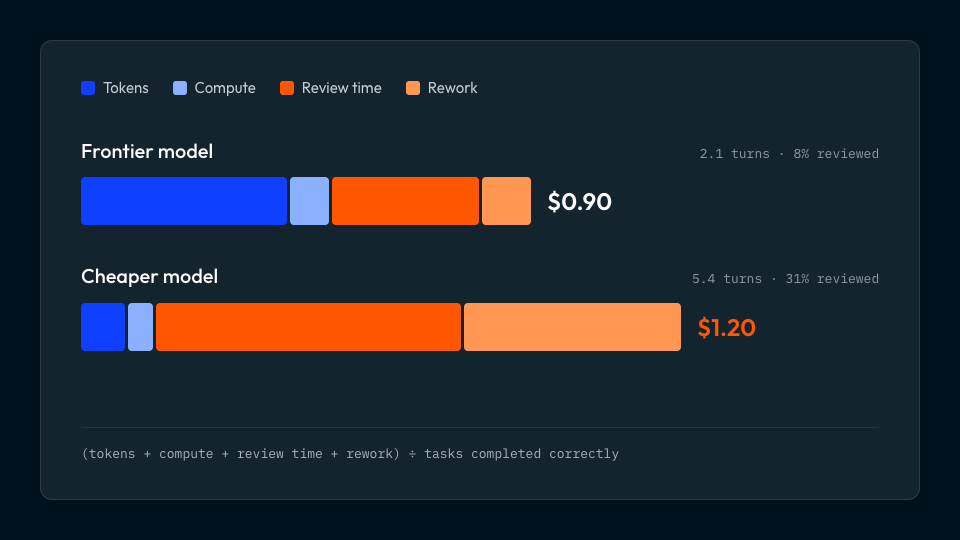
Token price tells you what the raw material costs.
To know what an agent costs, track what it takes to finish the work correctly:
Cost per completed task = (tokens + compute + review time + rework) ÷ tasks completed correctly
Three things make this number useful.
Break it down by agent and by step. A total from your provider can’t tell you which agent, tool call, or retrieval step is burning the budget. You need cost, latency, and errors per span, across every agent, to find the loop or the bloated retrieval.
Pair cost with quality. A cheap agent that’s wrong half the time is the most expensive agent you have. Cost per task only works if you also know which tasks were completed correctly.
Watch it after every change. New model, new prompt, new data source, new agent calling yours. Each one can move the number. Baseline before the change, compare after, and keep watching, because drift often shows up weeks later.
Know which agents earn their cost
The goal is one view that shows, for every agent, what it cost last week and how often it got the work right. With that, you can decide which agents to scale, which to fix, and which to retire before the budget meeting.
Getting there takes four things. You need cost, latency, and errors by span across every agent, so you can find the loop or the bloated retrieval.
You need monitoring on the data agents retrieve through RAG and tool calls, so you can see when bad context drives up both tokens and mistakes.
You need validation on every trace, so “completed” means completed correctly. And it all has to work across every model you use, so you can switch or route models when pricing changes and see whether the switch saved money.
Monte Carlo’s agent trust platform gives you all four in one place.
When token prices drop next quarter, you’ll know which agents got cheaper and which just got busier.