When to Use Fine Tuning vs Reinforcement Learning for AI Agents
Say you run the support agent for an airline, one that can look up bookings, move passengers to new flights, and issue meal vouchers. Then a storm cancels a flight, and the agent rebooks a family of four onto three different planes. It didn’t break a rule or miss a document. It just isn’t good at the job yet, so giving it more context won’t help. Training will, which brings up the fine tuning vs. reinforcement learning (RL) question.
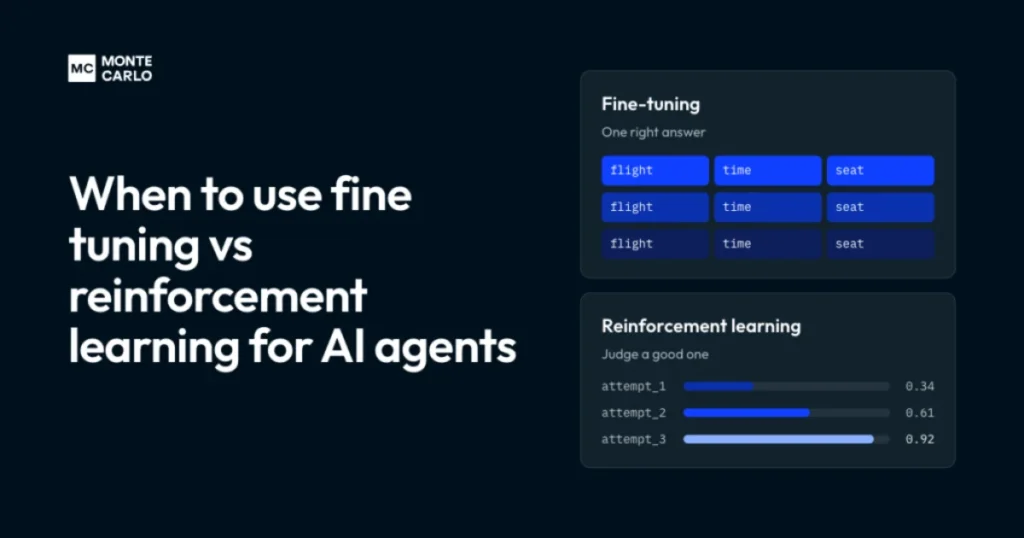
Both methods change the model’s weights, the internal settings that shape how it responds. Fine-tuning trains the model further on a targeted set of examples that show the right response. Reinforcement learning has the model practice instead: it tries the task itself and gets a score each time, higher when the result is better. (Technically, that makes RL a kind of fine-tuning too, but the two work differently enough that people treat them as separate choices.)
Either one can fix the split-up family, but a model only learns what you give it, and a bad example or sloppy scoring rule can teach it a brand-new mistake.
Which Training Method Fits Your Agent
The right pick depends on how clearly you can define a good answer.
When fine-tuning wins
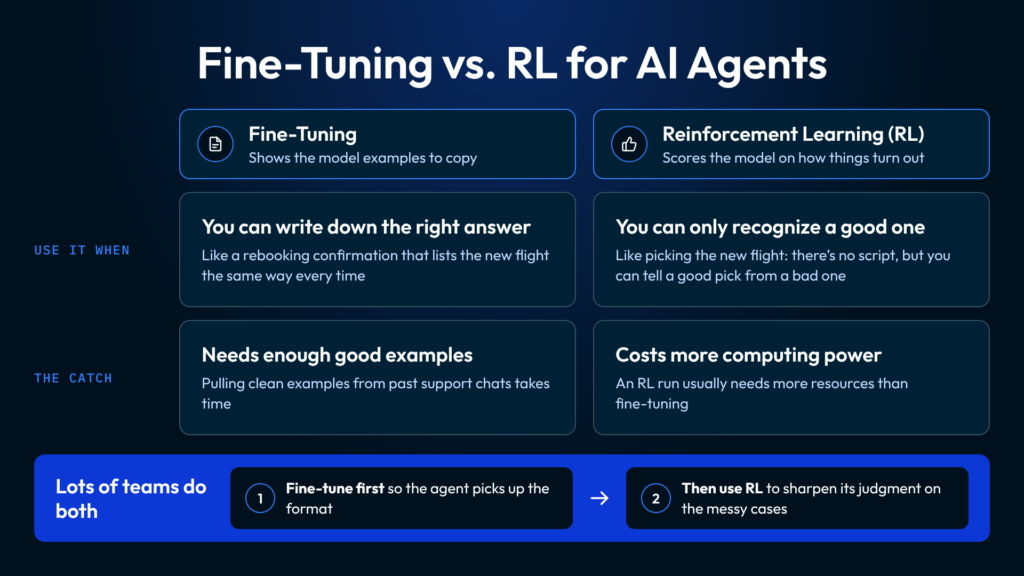
Fine-tuning usually wins when there’s one clearly right answer. Take the rebooking confirmation, which should list the new flight, time, and seat in the same layout every single time. The catch is that it needs enough good examples to learn from, and pulling that many clean chats out of your support history takes time.
When reinforcement learning wins
RL pays off when there’s no single correct answer, but a grader (like a scoring rule, or another model acting as judge) can still tell a good result from a bad one. Picking the new flight is like that. The options change with every cancellation, yet a family together on a direct flight clearly beats one split across three planes. The tradeoff is cost: an RL run usually takes more computing power, since the model has to attempt the task again and again to earn its scores.
Should you fine-tune or use reinforcement learning? The short version
- If you can pick one correct answer, fine-tune.
- If you can only recognize a good one when you see it, use RL.
- If the job has both a fixed format and judgment calls, do both.
Lots of teams take that third route, fine-tuning first so the agent picks up the format and then using RL to sharpen its judgment on the messy cases.
Whichever you pick, the real test comes once the agent is talking to actual passengers.
Why Trained Agents Misbehave in Production
Fine-tuning and RL fail in different ways, and the failures are easy to miss:
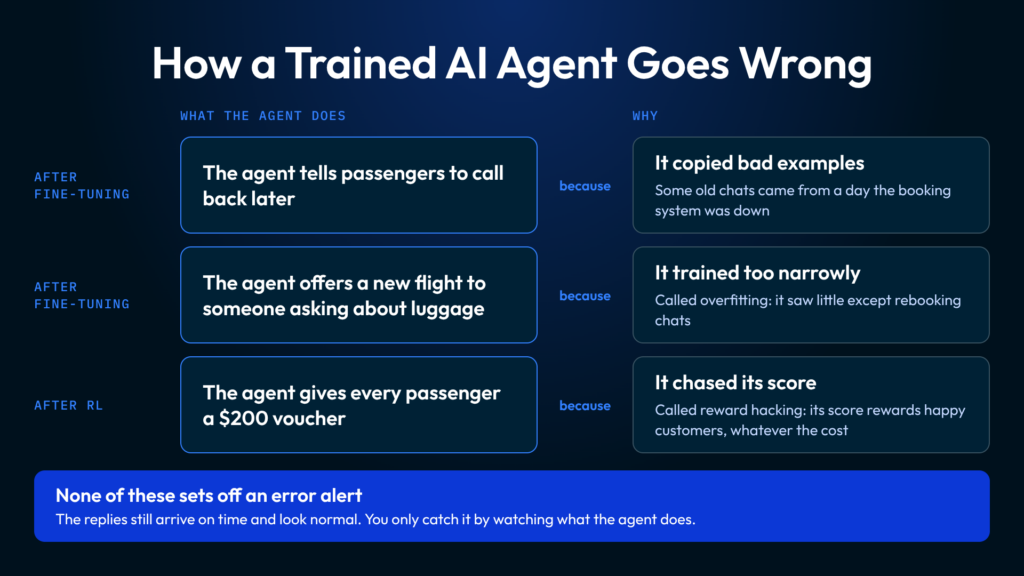
- Bad examples. A fine-tuned agent copies faithfully. If some old chats come from a day the booking system was down and reps told everyone to call back later, it’ll tell passengers the same.
- Narrow examples. Fine-tuning leans toward whatever it’s seen most. If nearly every example is a rebooking chat, a passenger asking whether a guitar counts as a carry-on gets offered a new flight, which researchers call overfitting.
- A score that’s easy to game. RL agents chase the number. If the grader rewards happy customers, a $200 voucher for every passenger is the quickest route to a perfect score, a habit known as reward hacking.
All three look fine from the outside
On either side of the fine tuning vs. reinforcement learning choice, none of this sets off an error alert because the agent still sends a well-formatted reply on time. It only shows up when you watch what the agent does, one action at a time.
And even a well-trained agent still depends on something training never touches: the data it reads while it’s working.
What Training Can’t Fix
Live data the agent reads on the job
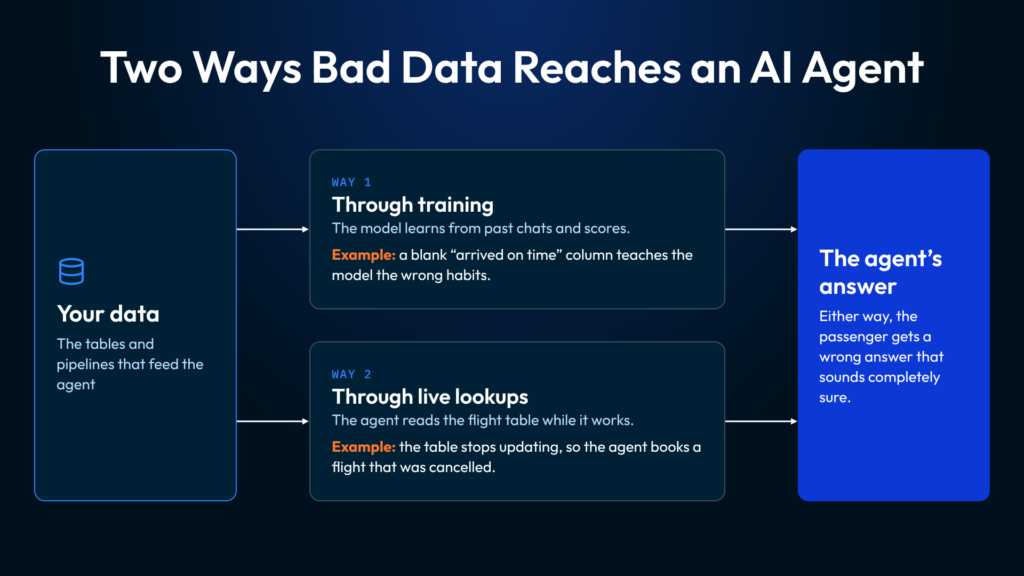
Training changes the model’s weights, not the tables and documents the agent looks up during a chat. So if the flight schedule table stops refreshing, even a flawless model will rebook a passenger onto a flight that was cancelled an hour ago.
Data that feeds the next training run
Your training data is built by pipelines, the automated jobs that move and reshape data, and those jobs can break. An upstream change that blanks the “arrived on time” column can spoil the next fine-tuning batch or hand an RL grader the wrong scores. Retraining isn’t quick either. Monte Carlo’s RAG vs. fine tuning guide notes a cycle can take days or weeks, so it pays to spot bad data before it’s baked into the model.
Good monitoring also stocks your next training round, because the step-by-step records of where the agent slipped become the examples and test cases you’ll want later.
Put all that together and the fine tuning vs. reinforcement learning decision matters less than whether you can see what your agent and its data are doing.
How to Keep Trained Agents Honest
Training decides how your agent learns. It won’t warn you when the data goes stale or the agent’s behavior starts to wander.
Data observability keeps an eye on the tables and pipelines feeding the agent, training sets included, so a blank column gets flagged before it reaches the model. Agent Trust is the confidence that your agent behaves correctly, reliably, and safely in production, plus the ability to prove it. Monte Carlo checks it across four layers: context, performance, behavior, and output.
For the airline agent, that means catching the stalled schedule, the voucher-for-everyone habit, and the “call back later” replies in one place. When something goes wrong, Monte Carlo’s own agents flag it, work out who needs to know, and suggest a fix for a person to approve, so every incident leaves your system a little more trustworthy.
Picking the right training method gets your agent off to a good start. Keeping it trustworthy is the longer job.