Your Agents Will Ship Before Your Homegrown Monitoring Does
Your first agent went to production in a few weeks. The plan for monitoring it was reasonable: build it ourselves. You know your stack, you can start today, and there’s no procurement cycle in the way.
Surely, homegrown monitoring makes sense, right?
Then the second agent shipped, and the fifth. The monitoring is still on the roadmap.
That’s the core problem with building an agent trust platform in house. Agents ship in weeks, but a platform that keeps them trustworthy takes years to build, and your agents simply don’t wait for it.
Building first is often the right call
For a lot of teams, building first makes sense. If you have one or two agents in production, you’re still learning what you need. You’re iterating on prompts, tools, and architecture. Token volumes are small, and open-source tracing gives you enough visibility for now.
Building at that stage teaches you what matters. The trouble starts when the agent program grows faster than the tooling.
Around the fifth agent, the math changes
In the teams we work with, the same problems tend to show up together, at around the fifth agent in production:
- Token costs start appearing in budget reviews.
- Maintaining the tooling competes with shipping new agents.
- Gaps in coverage cause incidents that take too long to investigate.
- Agents start writing to production systems or acting on their own, so a failure costs more.
By the time a team notices all four, it has usually spent months on a system it’s about to outgrow.
You’re building three systems
Part of the problem is scope. Monitoring agents in production takes more than tracing.
Your data. Agents read from your warehouse, so you need freshness, volume, and schema checks, column-level lineage, and a connector for every source. The hard part is breadth: every new table needs coverage, and every vendor update can break a connector.
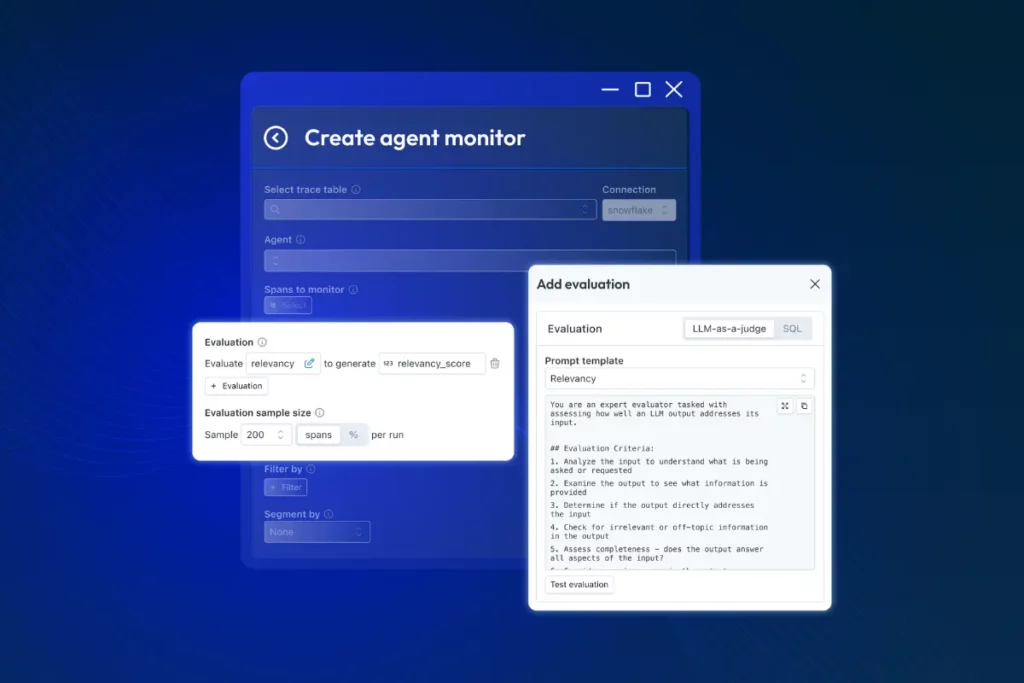
Your agents. You need to know whether each agent got the right context, what each step cost, whether it used the right tools in the right order, and whether the answer was any good. The hard part is running cost. Evaluations built on general-purpose models pay for the whole conversation every time they run. A conversation that starts at 5,000 tokens can pass 40,000 by turn ten, so most teams end up checking a fraction of calls.
The agents that run it. Agentic operations means agents that profile your tables, set up checks, triage alerts, and fix issues without anyone writing rules by hand. This is the part that takes reactive work off your team. It’s also agent engineering, with no reference design to copy, and it’s the last thing a build gets to.
AI coding tools speed up year one, not year two

AI coding tools have made building look easier, and for year one they genuinely help. Year one is mostly code: detectors, the lineage graph, connector scaffolding, dashboards, and alert routing.
Year two is mostly tuning. Baselines have to learn your seasonality. Sensitivity has to be set table by table, based on which alerts people acted on. Noise has to come down before your team stops looking. All of that runs on a record of how your team responds to alerts, and only time builds that record.
The gap between shipping and watching
Put the timeline together and the problem becomes clear. In our modeled build for a mid-sized enterprise, matching a bought platform takes about 24 months. Agentic operations doesn’t start until month 19.
Meanwhile, your agents are in production. At month 24, a typical build has manual thresholds, lineage for one warehouse, and traces in a dashboard with roughly one call in ten checked. Every agent you ship during those two years runs with partial coverage.
The cost follows the same curve. For a composite company with 30,000 tables and a mid-sized agent program, we modeled about $5.14M to build over three years, against about $0.98M to buy. The build ties up 7 to 10 engineers at its peak, and once it works, keeping it running costs 30 to 40% of the original build every year. Your numbers will differ with salaries, table count, and agent volume, but the shape usually holds.

What teams who built their own tell us
Most teams that build their own start for good reasons. The challenges they describe later are consistent: hand-written rules pile up faster than anyone can maintain them, one custom tool gets replaced by another, and engineers hired to build products end up on call for the tooling.
A healthcare CTO summed it up: “I want to be in the business of putting out more agents, not in the business of building out observability frameworks.”
Questions to ask before you build
If you’re weighing a build, four questions will tell you a lot:
- How many agents will be in production in 12 months? If the answer is more than a handful, plan for the point where the tooling can’t keep up.
- Who maintains it? Every connector, threshold, and evaluation needs an owner, and that work never ends.
- What will your checks cost to run? Model the token bill for evaluating every call, not a sample.
- When do you get agentic operations? If the answer is two years out, decide what happens to your agents in the meantime.
Get the full breakdown
Our Build vs Buy guide walks through the full model: the three parts of an agent trust platform, the year-by-year timeline, the first-year budget line by line, and the three-year comparison. If you’re weighing a build, we’ll run the numbers against your own team, tables, and agents.