Scale Trust at the Speed of AI with Bayes, Your New Monte Carlo AI Teammate

Every enterprise is working to scale their agents in production, but nearly all of them hit the same wall.
It’s not the models or the frameworks that are limitations, and it’s certainly not ambition. The problem is trust, and it becomes more and more elusive with every deployment.
While a typical AI engineer can keep one to three agents and a handful of critical pipelines under watch, maintaining reliability beyond this point becomes difficult.
Each new agent adds evaluation and debugging work that never goes away. Agents ship, act, and fail at machine speed, but trust is still managed by humans. It simply can’t keep up, which means that rollouts stall and organizations are prevented from realizing the true benefits of their AI initiatives.
Today we’re launching Bayes, Monte Carlo’s AI teammate, to close that gap. It brings all of Monte Carlo’s capabilities into a single, intelligent core that observes, fixes, and continuously improves agents and the data that powers them.
Bayes learns each customer’s environment, does the work as issues surface, and takes on as much autonomy as your team is ready to hand over.
When agents outrun human trust
The AI failures that hurt enterprises the most in production are rarely obvious.
We’ve reviewed a lot of agent traces with customers over the past few months, and noticed a pattern that keeps showing up:
An agent’s run completes with every query succeeding, a status code of 200 is reported, and all of the evals pass. The output, however, is still wrong, and it’s not clear as to why.
Here are a couple of ways this has manifested across anonymized real customer use cases:
- An analytics agent wrote correct SQL, then quoted the value from the column next to the right one. The figure was 6.5x off, and the agent came to the wrong conclusion even though no error was reported.
- A financial data agent reported a week-over-week change of +19.9% when the two numbers it had already pulled worked out to a real difference of +12.6%. It did its own (wrong) arithmetic, even though its instructions explicitly prohibited that.
- A fintech agent showed zero errors, but half of every run was wasted on silent retries, resulting in unacceptable latency and unsustainable token usage.
The problem with failures like these is that typical dashboards don’t catch them, while golden datasets built before production can’t even anticipate them.
The only way to find these issues is to read through the trace data of what is actually happening in production, correlate it with the context the agent is pulling, follow that upstream to its data source, and then determine what needs to change to remediate the problem.
Humans can do this for one agent at a time, but not for every agent, every day.
An AI teammate, not another tool
Most tools in the AI evaluation space stop at detection. They surface a trace, a score, or an alert, and hand the rest to an engineer.
Monte Carlo’s AI teammate is built to do the intense, time-consuming work that lands on an answer and a real fix.
Bayes acts as the platform’s brain, learning the unique landscape of a customer’s data and AI environment, setting up the right monitoring, and calling on Monte Carlo’s capabilities (monitoring, triage, troubleshooting, and remediation) to resolve issues as they surface.
Unlike other tools, Bayes can traverse the full trust stack: examining the outputs agents produce, the decisions they make, the context they retrieve, and ultimately following the path all the way up to the data feeding them.
Here’s what that looks like in practice.
Bayes catches the failures real users hit
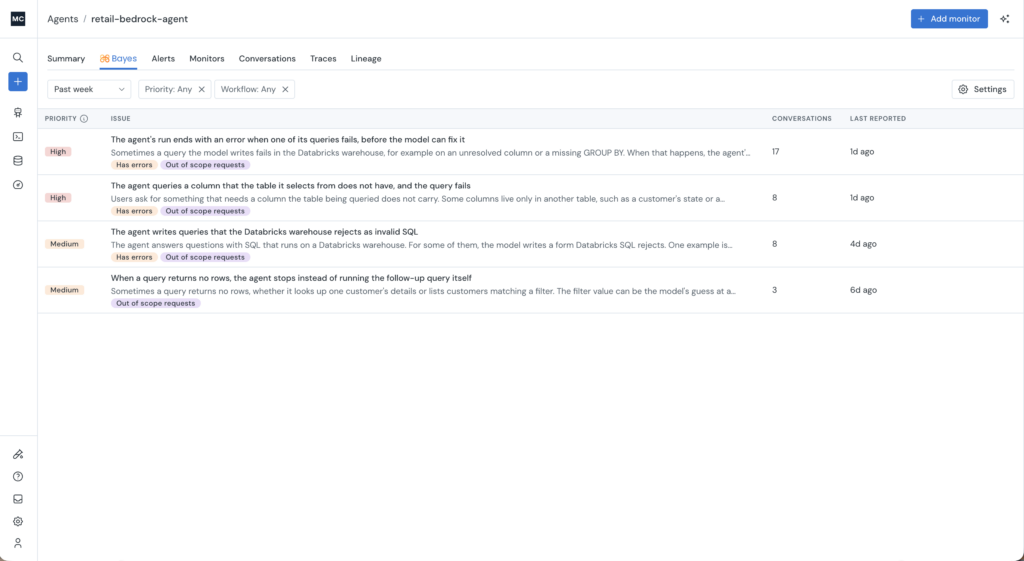
Bayes reads production traces: tool calls, model invocations, span timing, errors, retries, conversation structure, and eval results. It looks for the failures that matter to the people using your agents. You don’t have to hand-build golden datasets first.
Detection is grounded, not guessed. A library of deterministic detectors produces the evidence, and LLM judges only interpret it, so an LLM never invents a metric or originates a finding.
Bayes looks for the failure modes standard observability misses:
- Silent failures: empty or partial outputs that return normal status codes
- Tool cycling and retry loops: an agent stuck retrying a doomed call
- Wasteful model usage: outdated or oversized models burning tokens
- Latency bottlenecks and context-window overflow
- Output errors: answers that contradict the agent’s own data, and eval score drops
Every issue is categorized across the four dimensions of agent trust (context, performance, behavior, and outputs) and ranked by severity and confidence. An issue that Bayes can’t verify does not get reported.
Bayes fixes what breaks, then confirms the fix
Finding an issue is half the job; Bayes goes further.
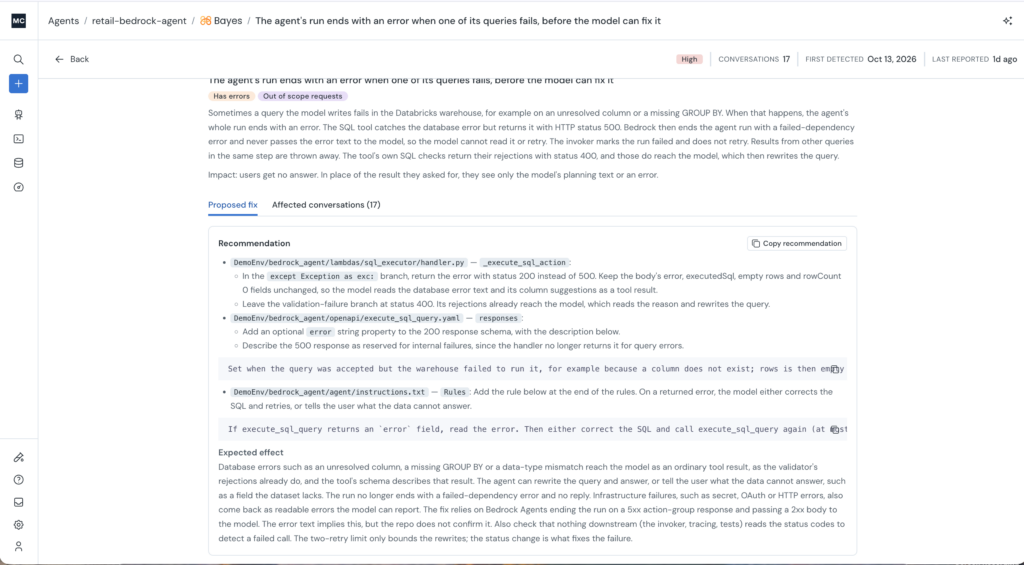
Before it shows you anything, Bayes checks two things: is the issue real (validated against runtime evidence and, where connected, your source code), and is it already fixed (checked against your recently merged PRs)? You won’t get nagged about something your team fixed last sprint.
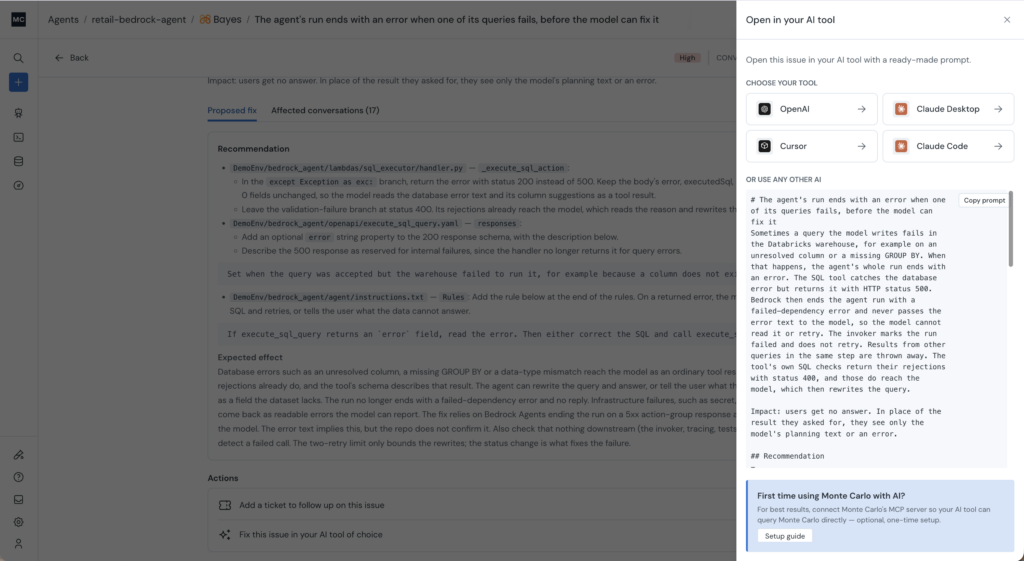
Then it explains the root cause, cites the evidence, and delivers the fix in the agent’s own terms. That might be a draft PR with the change, a ticket in Jira or Linear, or a Monte Carlo monitor to catch regressions. When the fix lands, Bayes confirms to you that it worked.
This is what makes agents self-improving. Every fix becomes the new baseline for the next run, so agents get better over time instead of drifting.
When we ran this on one of our own internal agents, Bayes found two pipeline steps calling a previous-generation model across roughly 600 calls per analysis window. The issue was visible in traces all along, but nothing had surfaced it. Bayes flagged it with the exact config reference, and a draft PR with the fix followed automatically.
Bayes watches the data underneath your agents
An agent is only as trustworthy as the data it retrieves. That’s where Monte Carlo started, and it’s what agent-only tools can’t see.
Bayes monitors the pipelines, tables, and data products your agents depend on, and it builds that coverage for you. It identifies the highest-value use cases in your data estate using lineage, query patterns, and downstream consumers, ranks assets by criticality, and deploys the right monitors within a budget you set. The most critical tables get deeper profiling, metric, and validation monitors. Coverage adapts as new tables appear and usage shifts.
When alerts fire, Bayes triages them, recognizing when a dozen downstream freshness alerts all trace back to one upstream failure and treating them as a single incident. It auto-resolves noise with a logged rationale, and it escalates only what needs a human, with root cause and affected assets attached.
Because agents and data live in one view, with lineage from every output back to its source, your team knows right away whether a bad answer is a data problem or an agent problem.
Bayes shows its work and learns from yours
Trust in an AI teammate has to be earned, so nothing that Bayes does is a black box.
Every action is logged with its full chain of reasoning: why it deployed a monitor on a given table, every hypothesis it weighed during triage, and why it ruled each one in or out. By default you see only the exceptions that need your attention; everything else is one click away.
You don’t configure its learning in a settings page. When you override an auto-resolution, confirm an escalation, or dismiss a finding, Bayes learns from what you do and gets better at your environment over time.

Bayes works where your engineers already work
Bayes is available in the Monte Carlo platform, in Slack, and in Microsoft Teams. Through MCP, it connects to AI coding assistants and agent-first tools across the CI/CD pipeline, so fixes land directly in your existing development workflow, not in another dashboard to check.
Bayes takes on as much as you’re ready to hand over
Think about any new teammate: you might hand them one task today and a multi-quarter mandate next year. Bayes works the same way, with four levels of autonomy that can be adjusted to your team’s comfort level:
| Level | What it looks like |
|---|---|
| Manual | Your team does the work in Monte Carlo, with Bayes on hand when you ask. |
| Assisted | You give Bayes a specific job, like “troubleshoot this alert.” It does the job and you review. |
| Supervised | Bayes spots issues and proposes fixes before you ask. Your team approves. |
| Autonomous | Bayes runs in the background and comes to you only for exceptions. For example: “Set up monitoring for this domain, triage every 6 hours, troubleshoot high-priority items, and execute fixes.” |
You can steer it before it runs: point it at a domain, a set of data products, specific assets, or plain-language business context, or let it discover on its own. You can review Bayes’ plan before monitors go live, or let it deploy and audit after the fact.
Once it knows your environment, Bayes can pick up the jobs that your team does not have resources to support, like optimizing infrastructure cost and tracking regulated data.
What customers are seeing
Monte Carlo’s customers are already seeing benefits from using Bayes.
At a leading financial institution, a single engineer used it to deploy monitoring coverage across 88% of the company’s agents. Bayes detected 200% more incidents than their in-house system and flagged over 80% fewer false positives.
“Monte Carlo’s AI teammate detects more real incidents and generates fewer false positives than evals and monitors we set up in-house. That’s what gives us the confidence to scale.” — AI engineer, leading financial institution
“Every enterprise wants more agents in production, and every one of them hits the same wall: there aren’t enough engineers to keep those agents trustworthy. Bayes changes that math. It understands your agents and data together, fixes what breaks, and gets better at your environment every day. Teams can now spend less time firefighting and more time shipping.” — Barr Moses, co-founder and CEO, Monte Carlo
What partners are seeing
Bayes also extends Monte Carlo’s partnership with Snowflake, which named Monte Carlo its 2026 Data & AI Governance Partner of the Year. Together, the two companies help joint customers build and run reliable agents on Snowflake.
“As enterprises put Cortex Agents into production across the AI Data Cloud, trust in both the agents and the data behind them is essential to realizing the value of AI,” said Venkat Suru, Principal Partner Solutions Engineer at Snowflake. “Snowflake provides a governed foundation for that work, and Monte Carlo extends that foundation to observe, fix, and continuously improve agents and the data that powers them. Bayes is an exciting next step in our partnership, helping joint customers scale trusted AI with confidence.”
What this means for your team
- AI and agent platform leaders: Get more agents into production without adding headcount, and scale trust at the speed of AI.
- AI engineers: Ship more agents without drowning in debugging. Bayes detects, troubleshoots, and fixes failures; you handle the exceptions and approvals.
- Data engineers: Know right away whether it’s a data problem or an agent problem, with coverage built and tuned around what matters.
Available today
Monte Carlo’s Bayes AI teammate is available today to customers in the platform, in Slack, in Microsoft Teams, and through MCP.
If your current answer to “why did the agent do that?” is to assign an engineer many hours of investigatory work, let’s talk. Request a demo.