Agentifying Legal Ops: How an NDA Agent Automated a Sales Bottleneck at Monte Carlo

Most tech companies today utilize NDAs as part of their sales process.
Before a prospect can see Monte Carlo’s Trust Center, get into an architecture deep dive, or share the details of their environment, they must sign an NDA.
Most NDAs are nearly identical; they cover the same clauses and the same standard positions.
But every one of them sits on the critical path of winning a deal.
Issues arise when legal operations stall the deal’s momentum, like when a seller in London gets an NDA at 9 a.m. and must wait until business opens in the U.S. for approval. A multiweek sales cycle can lose days to a document that, most of the time, ends up approved as-is.
Our Head of Legal, Lucas Thomas, decided that shouldn’t be the case, and solved this point of friction by agentifying the operational hurdle.
Today, a Monte Carlo seller can upload an NDA and get a decision in 30 seconds or less, at any hour and in any time zone. If the NDA is standard, they send it for signature without involving legal at all. If it isn’t, it goes straight to the Head of Legal with the issues already identified.
Agentifying this process took some work, and taught us some important lessons about where agents belong in legal work and where they don’t.
Version one: an agent on a schedule
The first version came out of Monte Carlo’s company-wide AI sprint in March, when every team, Legal included, was challenged to put a working agent into production.
Lucas built an NDA review workflow he called LucasBot, which received NDAs that sellers forwarded to him through Slack or email. Every hour, an agent picked them up, reviewed each one against Monte Carlo’s standard positions, and sorted it into one of two categories:
- Green: acceptable as-is. The agent filled in Monte Carlo’s company details and returned a clean copy, ready for signature.
- Red: flagged for a closer look. Lucas would review it and send back a redline.
Our ambitious Head of Legal didn’t stop at NDAs, however.
The same sprint produced an agent that reviews customers’ security exhibits against our security posture and returns a redlined document with tracked changes. A separate agent files fully executed contracts into the right folder automatically.
The greatest impact in agentifying these operational workflows was not really time saved. Lucas put it this way: “The 10% that’s automated was never where my time went. It was where my attention went.”
Routine document intake was the kind of work that kept pulling a critical resource, legal expertise, from higher-judgment tasks. Automating as much of this as possible meant Lucas was no longer switching back and forth high-judgment work and routine approvals.
Version two: self-serve within familiar tools
That first version worked, but it still ran through Lucas’s inbox and relied on an hourly schedule. Sellers had to send the NDA to him and wait for the next run.
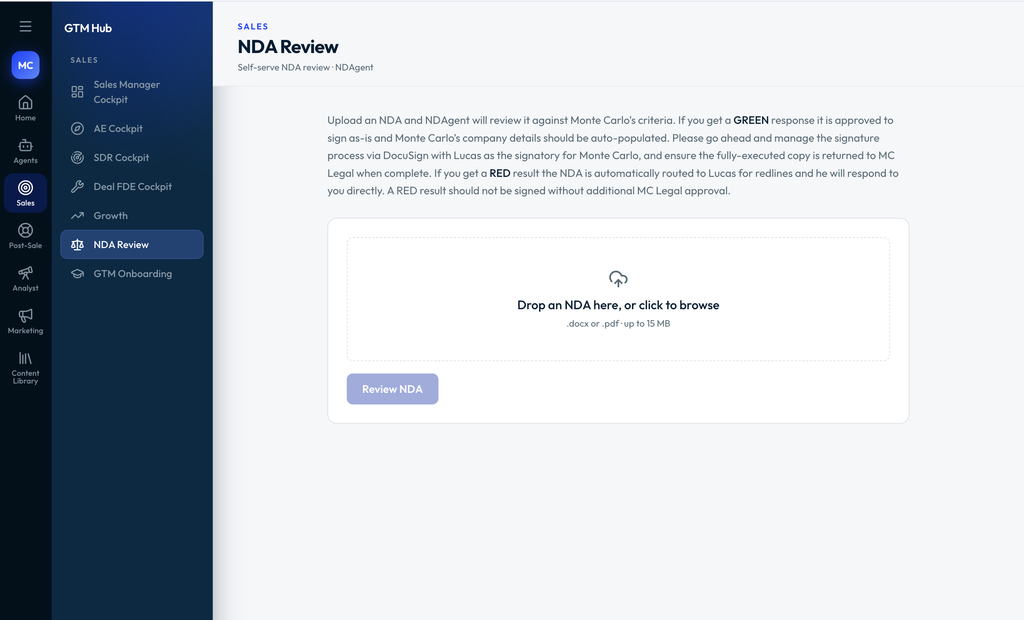
A major transformation happened months later, when this workflow was rebuilt as NDAgent, a page in our internal GTM Hub.
We’ve written a few times about the GTM Hub, an internal web application that serves as a centralized resource for Monte Carlo’s salesforce. It enables them to agentify many of their own sales workflows, access relevant research and insights, pull content they need for outreach, keep up with events and marketing campaigns, and even execute on contract tasks.
NDAgent sits in the GTM Hub alongside the account views, pricing tools, and content sellers already use every day.
The flow is simple:
- The seller opens GTM Hub → Sales → NDA Review and uploads the NDA.
- The agent reviews it in 30 seconds or less.
- If it’s approved, the seller sends it for signature right away. No legal review is needed.
- If there’s an issue, the NDA goes to Lucas automatically, with the specific reasons it was flagged.
When Lucas announced the launch, he described the goal as giving the team the ability “to more quickly execute NDAs 24/7 across all time zones,” so that prospect conversations, Trust Center access, and deal timelines stay on track while Monte Carlo’s most sensitive information stays protected.
What the agent checks
It’s critical to note that Monte Carlo’s NDAgent isn’t making open-ended legal judgments. Rather, it’s applying a defined set of criteria that reflect the positions Lucas, the human, would take himself.
Here are some of the reasons it has flagged NDAs recently:
- Governing law outside approved jurisdictions. Several NDAs specified foreign courts rather than one of the jurisdictions we accept.
- One-way NDAs. Agreements that protected only the other party’s confidential information and left Monte Carlo’s own IP uncovered.
- Marking requirements. Clauses requiring confidential information to be explicitly labeled as confidential before it’s protected.
Every decision, approved or flagged, is posted to a dedicated Slack channel with the file, who requested the review, and the reasons behind the decision. Lucas sees what the agent approved as well as what it escalated, so there’s a running audit trail of every call it makes.
NDAgent works well exactly for that reason – the standard positions are documented explicitly enough for an agent to apply them consistently.
Intelligence vs. judgment
A few weeks after launching the first version, Lucas wrote a reflection that shaped how we think about agents in legal work, and in other functions too.
His point was that most of what a lawyer does is not intelligence, but judgment. Those are two different things.
Intelligence recognizes patterns. Agents are very good at this. They can tell you if an NDA differs from our standard positions, or if a security clause conflicts with what is in our Trust Center.
Judgment, however, depends on context and experience. A human can conceptualize how significant a deal is to the company, what the relationship history looks like between Monte Carlo and the customer, and whether there’s a business reason to accept a certain amount of legal risk. Evaluating many complex factors and advising on a decision is a very human skill.
Why this matters beyond legal
NDA review is a small workflow, but it shows a pattern we see across Monte Carlo and across our customers.
The best early candidates for agentification share a few traits: the work is repetitive enough to automate, well defined enough to write down, and important enough that the delay it causes is a problem to be solved.
An additional lesson from this, and other AI endeavors we have embraced: traceability is critical.
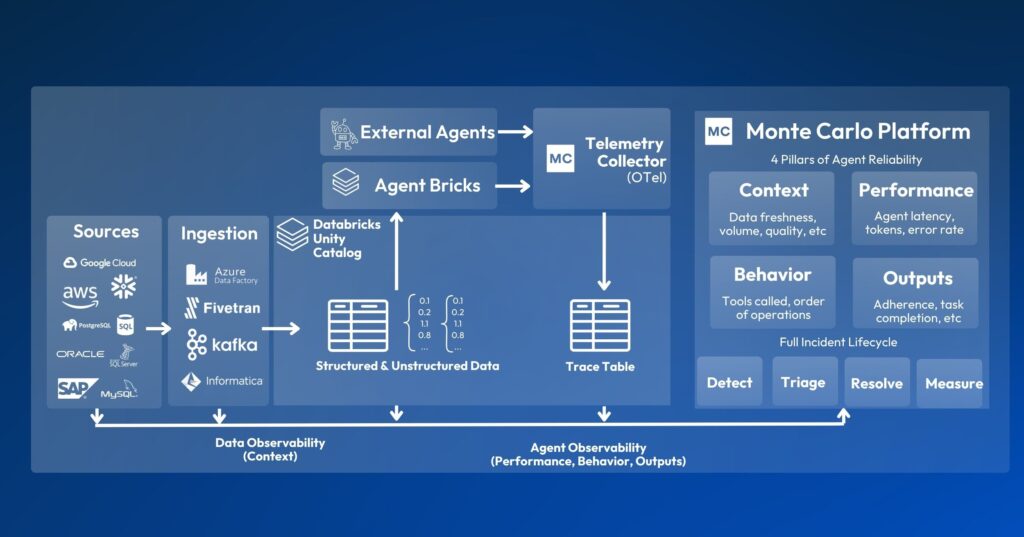
Once an agent is making decisions on your behalf, you need to be able to see those decisions and catch it when they start going wrong. For NDAgent, that visibility comes from every call being logged and reviewable. For the agents our customers are putting into production, running on data that changes every day, that’s the problem Monte Carlo was built to solve.