Who Owns the AI Platform? 4 Organizational Patterns Emerge Across Industries
The rise of the AI platform team
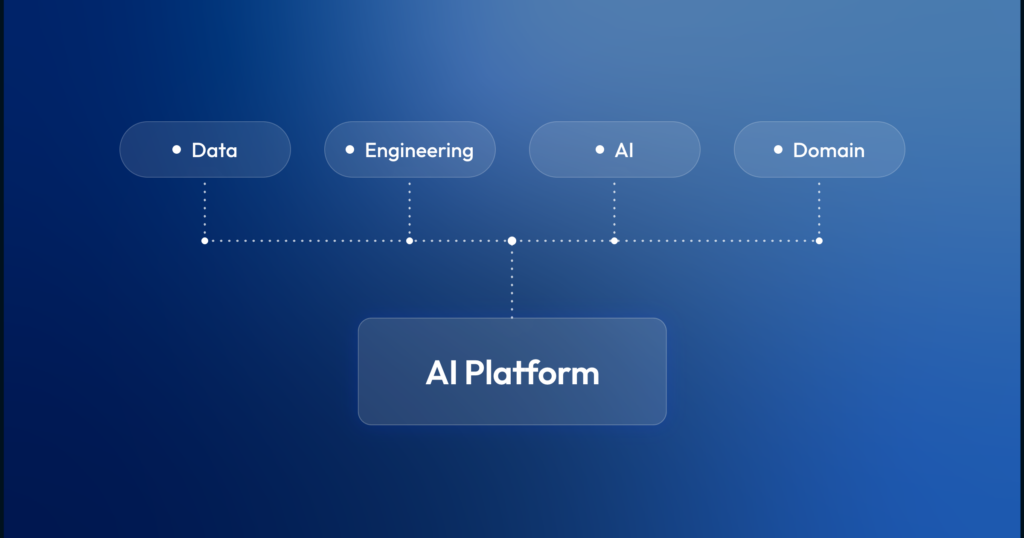
A few weeks ago, we wrote about the rise of the internal AI platform team, a dedicated function that’s emerging to tame the sprawl of models, gateways, agents and inference bills as enterprise AI scales in production. The response to our piece was strong, and we learned that nearly everyone we talk to in the AI and data space is building one, joining one, or trying to determine the organizational position for this new team.
If you look at the hiring data, it points to a similar story of growth, one that extends far beyond the tech industry now.
US job titles that mention AI grew from 264 in Q1 2022 to 822 in Q1 2026, and 63% of them now sit outside tech occupations.
Axial Search now counts 43,480 US AI engineering postings in 2026, up 14% quarter over quarter. 47% of these come from companies with more than 10,000 employees; it’s not just agile startups hiring for AI talent, it’s everyone.
Beyond the practitioner layer, however, we’re also now seeing AI leadership roles emerge with varying titles and varying reporting structures.
Here are a smattering of high-profile examples from 2026:
- RBC created an AI Group reporting to its CEO
- HSBC named its first Chief AI Officer,
- Citi named a Group Head of AI and launched its Arc agent platform
- Lloyds brought in a Chief Data & AI Officer
- Bank of America named a head of platforms AI transformation in its global markets business
- Bank of Ireland’s first Chief AI Officer, a former Citi AI leader, took up the role.
As these examples suggest, the “AI platform team” doesn’t mean the same thing everywhere.
Looking across public announcements, recent job postings, and our conversations with data and AI leaders, we see four distinct patterns in where the team sits. There are advantages and disadvantages to each organizational approach.
Four patterns at a glance
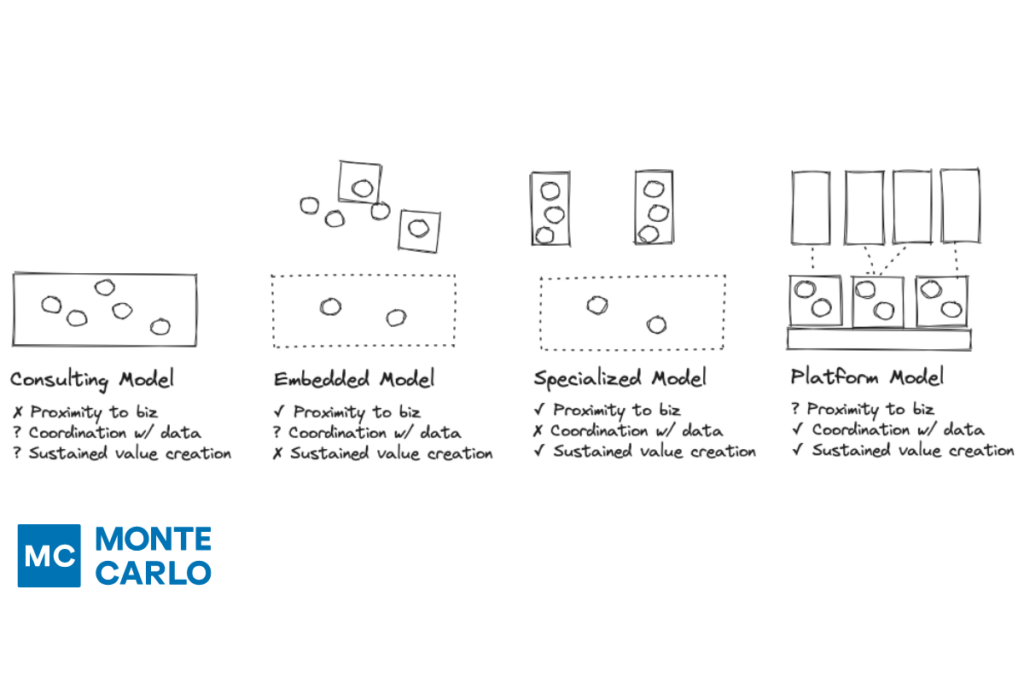
We have started to see AI platform teams fall into one of four models across most organizations, with some outliers taking on a hybrid approach:
| The team | What it optimizes for | Where we see it most | Public examples |
|---|---|---|---|
| 1. Combined with data The AI platform grows out of the data platform org and reports to a Chief Data (& AI) Officer. | Grounding AI in governed, trusted data; inheriting existing access controls and lineage; cost attribution | Banking, telecom, insurance, industrials | JPMorganChase (LLM Suite, CDAO office) AT&T (Chief Data & AI Officer) Verizon (AI Platform Engineering in Data Intelligence) Lloyds (Chief Data & AI Officer) Honeywell (Data Engineering, AI & ML Platform) |
| 2. Engineering-led Platform engineering for AI. Reports to the CTO or CIO and grows out of infrastructure, developer experience or MLOps. | Developer velocity: model gateways, SDKs, agent runtimes, evaluation in CI | Retail, tech & SaaS, investment banking | Goldman Sachs (CIO org, GS AI Assistant) HSBC (CTO owns the central model platform) \Walmart Global Tech (Wibey) Target (AI Platform) Home Depot (AI Platform Engineering) |
| 3. Standalone AI org A new executive AI function (Chief AI Officer, Group Head of AI, Office of AI), often reporting to the CEO or COO. | Enterprise-wide adoption, cross-business prioritization and a measurable AI value target | Large universal banks, wealth management, big-box retail | Citi (Group Head of AI, Arc) RBC (AI Group reporting to the CEO) HSBC (first Chief AI Officer) Walmart (EVP, AI Acceleration) Edward Jones (AI Platform team in EJ Labs) |
| 4. Split by domain Two platforms: one for employee and enterprise AI, another for core scientific or operational AI. | Domain depth and regulatory fit (e.g., GxP validation, scientific data, IP) | Pharma & life sciences, telecom | Novo Nordisk (Bedrock employee platform + Azure R&D platform) Eli Lilly (TuneLab R&D model platform) Genentech (agentic drug discovery systems) Verizon (network intelligence alongside enterprise AI) |
Placement is based on company announcements and recent job postings; reporting lines change frequently.
Pattern 1: Combined with data
In this model, the AI platform is an extension of the data platform. The same Chief Data Officer (increasingly retitled Chief Data & AI Officer) who owns the warehouse, lineage and access policies also owns the model gateway and the agent tooling.
Why it shows up where it does
This pattern is most common in banking, telecom and insurance, where a critical part of AI initiative success is data management rather than purely model access. Customer records, transaction histories and network telemetry – all of these are governed by regimes that these companies spent a decade building. When the data org already controls human access rules, extending that governance to control what an agent can access is often the shortest path to getting AI approved for production use cases.
This approach is also a natural choice for cost control. Telecoms, for example, run enormous volumes of AI requests, and data teams already know how to bill internal teams for shared infrastructure. A recent Verizon posting for its AI Platform Engineering team, which sits in the company’s Data Intelligence organization, describes a single gateway that “routes every AI request across all business units.” The team also keeps a registry of every agent, controls which tools those agents can reach, and bills each business unit for its own AI usage.
Combining the AI platform team with an existing data unit is a weaker fit for digital natives, however. In these cases, engineers adopt coding agents bottom-up and the data team is one consumer among many, rather than the gatekeeper.
Advantages
- Governance comes built in. Access controls, lineage and data classification already exist and can be extended to models and agents.
- Context lives next to the source. Retrieval pipelines, embeddings and semantic layers sit with the people who know the data best.
- One owner for the hardest question: what data did the agent see, and was it right?
Limitations
- Data teams don’t always have the software engineering and runtime expertise that agent infrastructure demands (latency SLOs, tool calling, failover).
- AI can end up treated like another analytics workload, which slows down product teams that want to ship.
- If the platform is slower than calling a provider directly, developers route around it.
Spotlight: AT&T
AT&T’s AI platform is run under Chief Data & AI Officer Andy Markus. The company launched its internal assistant, Ask AT&T, to developers in June 2023 and had extended access to more than 30,000 employees within three months. In late 2025 it added Ask AT&T Workflows, a drag-and-drop agent builder.
The payoff shows up in cost. In July 2026, AT&T described its AI Gateway, which uses cache-aware routing and can even switch models partway through a multi-turn session. It now handles an average of 45 billion tokens per day, “reducing AI costs as much as 90%, already saving millions.”
The same team post-trained its own model on more than 400 billion tokens. The New York Times reported that routing routine coding requests to open-source models alone cut AT&T’s AI coding costs by 56%.
Pattern 2: Engineering-led
In this organizational model, the AI platform is essentially platform engineering for AI. It reports to the CTO or CIO and usually grows out of infrastructure, developer experience, or an existing MLOps team. The data organization is a consumer, not the owner.
Why it shows up where it does
This is the default wherever software is the product or the operating backbone: e-commerce and retail technology, SaaS, and trading. Engineers are the original heavy AI users, so the first platform requirements are runtime needs: gateways, SDKs, agent orchestration and evaluation in CI.
CTO organizations already run platform engineering and SRE, so the AI platform slots in next to them. This is the DevOps-to-platform-engineering cycle repeating.
Retail job postings show what this looks like in practice. Target’s AI Platform, for example, is organized into Agent Platform, Context Intelligence and AI Developer Experience, with its own forward-deployed engineering team to drive adoption. Home Depot’s AI Platform Engineering team owns the “enterprise Generative AI platform” and its multi-model orchestration.
However, this model is spreading beyond retail and tech. In September 2026, Disney created its first CTO role, naming former Character.ai CEO Karandeep Anand to own enterprise technology, infrastructure, data and AI platforms under one roof, and reporting to the CEO.
Advantages
- Speed. Engineering-led teams ship self-serve tooling quickly and treat the platform like a product.
- Reliability practices carry over: CI/CD, SLOs, incident response and observability are known and established practices.
- Developer adoption. The people building the platform are the same kind of people using it.
Limitations
- The platform owns the pipes but not the context. The data feeding agents sits in another org, with its own priorities and roadmap.
- Governance and compliance can end up bolted on rather than designed in.
- Tooling tends to serve developers first, leaving business users with less.
Spotlight: Goldman Sachs
Goldman’s AI platform sits in CIO Marco Argenti’s engineering organization. The team built the GS AI Assistant, which Argenti describes as “really like your desktop for AI”. It was released to about 10,000 employees in January 2025 and rolled out firmwide that June. Argenti has also said that “pretty much every developer right now has AI in their IDE.”
Owning the engineering stack let Goldman move fast on agents. It piloted an autonomous coding agent alongside its 12,000 human developers in 2025 and has since co-developed agents with Anthropic engineers for trade accounting and client onboarding. It has also addressed the data gap directly: Goldman’s AI systems “don’t get direct access to underlying data sources” and go through the bank’s data platform instead. That’s a deliberate bridge between the engineering-led platform and the data org.
On Goldman’s Q3 2026 earnings call, CEO David Solomon said the financial industry’s experience “has demonstrated the value of rigorous testing, independent review and continuous monitoring and clear human accountability.” Those are exactly the guardrails an engineering-led platform has to design in rather than bolt on.
Pattern 3: Standalone AI org
In this model, AI gets its own executive function: a Chief AI Officer, a Group Head of AI, or an Office of AI, often reporting to the CEO or COO. The platform is one piece of a broader mandate that also covers adoption, change management, and business value.
Why it shows up where it does
This pattern clusters in very large, multi-line organizations (universal banks and global retailers) where AI touches every piece of the business, and leadership has made public commitments about its value. When the CEO is telling investors what AI will deliver, someone needs to own that number across every business line.
Walmart, for example, has an EVP of AI Acceleration, Product & Design who sits alongside its Global Tech organization.
This model is less common in mid-size companies, where a separate executive AI function can add overhead without adding much leverage.
For the right company, there is early evidence that having this dedicated role pays off.
The 2026 Wharton–GBK AI Adoption Report is a survey of 1,416 people at large U.S. companies. In this study, 58% of those who were managers or above at organizations with a newly designated Chief AI Officer reported strongly positive ROI. That fell to 24% where AI was added to an existing executive’s role, and 8% where no one owned it.
Advantages
- Executive sponsorship and the authority to set priorities across business lines.
- Clear accountability for ROI, often tied to a published value target.
- Adoption is a first-class goal, not something left to documentation.
Limitations
- The function can become a strategy layer without engineering ownership, relying on the CTO or CDO to build what it promises.
- Split ownership is common. At HSBC, the new Chief AI Officer drives adoption while the CTO’s expanded remit covers the central AI platform, which only works if the two stay tightly aligned.
- Without its own platform, it risks measuring activity (pilots, licenses) rather than production outcomes.
Spotlight: Citi
Citi named former CTO David Griffiths its Group Head of AI in 2026, putting enterprise AI under a dedicated leader. The results are some of the most detailed that any bank has published. Citi’s AI tools have rolled out to more than 180,000 people in more than 87 countries and jurisdictions. Employees have used these tools more than 65 million times since December 2024, with adoption above 87%.
The outcomes are also concrete. Citi reported that a coding agent re-mapped more than 30 years of legacy code in two days, while onboarding document review in their U.S. Services dropped from about an hour to 15 minutes.
In April 2026, Citi launched Arc, “a new platform that will allow us to build and scale AI agents across the firm,” where “every agent will be monitored, auditable and governed.” It’s starting with developers.
RBC has taken the model a step further. Its AI Group reports directly to the CEO and is building toward up to $1 billion in enterprise value from AI by 2027. Nearly 27,000 employees already use its RBC Assist tool.
Pattern 4: Split by domain
In the last of our observed patterns, we’ve seen that some organizations run two AI platforms on purpose: one broad platform for employee and enterprise use, and a separate, specialized platform for the core science or operations of the business.
Why it shows up where it does
This is most visible in pharma and life sciences. AI that drafts a clinical study report or predicts a molecule’s properties operates under very different constraints than, for example, an employee chatbot. It has to deal with GxP validation, proprietary scientific data, and IP sensitivity that requires strict guardrails and reliability requirements.
Recent job postings reflect this observed pattern, with roles like Genentech’s agentic systems for drug discovery sitting inside R&D rather than enterprise IT.
Advantages
- Domain depth. Scientists and operators get tooling built for their work, not a generic chat interface.
- Regulatory fit. Validation and audit requirements can be designed into the specialized platform from day one.
- Speed in each lane, since neither platform waits on the other’s roadmap.
Limitations
- It brings back the sprawl the AI platform team was created to fix: duplicate gateways, evaluation frameworks and cost tracking.
- There’s no single view of AI spend, risk or quality across the company.
- Shared standards and a federation layer are needed, or the two platforms drift apart.
Spotlight: Novo Nordisk
Novo Nordisk runs both lanes at scale. Its employee platform on Amazon Bedrock, owned by its data science organization, has let more than 25,000 employees build chatbots for over 2,500 use cases, at around $10 a month per use case. It has also shortened the innovation cycle from several months to a couple of days.
On the science side, Novo built a dedicated AI platform on Azure with Microsoft Research for R&D, producing a cardiovascular risk algorithm that predicts “better than the best clinical standards.” For regulated documentation, its NovoScribe system cut clinical documentation time from more than 10 weeks to 10 minutes.
The future of the AI platform team
There’s no single right answer as to how organizational lines will shake out when it comes to the AI platform team, and the patterns are already blurring.
Engineering-led teams are building bridges to the data org, as Goldman has, while standalone AI orgs are partnering closely with CTOs, as at HSBC. Split-domain companies are looking for a common layer on top.
Whichever model a company starts with, mature teams end up owning the same layers we described in our first post: model access, evaluation, context and retrieval, agent runtimes, guardrails, and cost and observability.
Where the team sits mostly decides which of those layers it is able to develop quickly based on their expertise, and which it has to work hardest to catch up on.
Consolidation matters too: in the same Wharton AI adoption study we referenced in an earlier section, half of organizations that standardized on a single approved AI platform reported strongly positive ROI. This is compared to only 9% of organizations who reported they were still experimenting and did not have a defined approach.
For leaders deciding where their own AI platform team should sit, three questions are a good start:
- Who owns the data your agents depend on?
- Who owns the runtime those agents execute in?
- Who is accountable for the value AI is supposed to deliver?
In many cases, there may be three completely different people responsible for each. There is nothing wrong with that, but it is a factor you will have to design around.